When anxiety spikes, alcohol can seem like a fast way to turn down the volume.
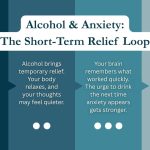
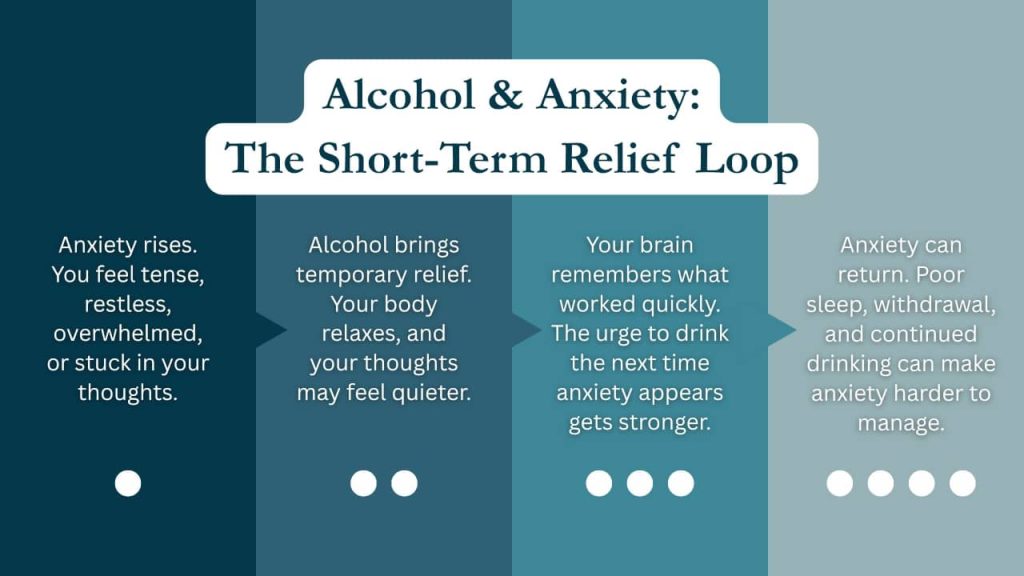
A drink may loosen the tension in your shoulders after work. It might make a crowded party feel easier or quiet the racing thoughts that show up at night. When alcohol seems to work quickly, it makes sense that your brain might start filing it away as a solution: I feel anxious. Drinking makes me feel less anxious. I should drink.
The problem is that relief and recovery are not the same thing.
Alcohol may reduce anxiety temporarily, but relying on it can strengthen a cycle in which uncomfortable feelings become harder to tolerate without drinking. Over time, heavy alcohol use and repeated withdrawal can also intensify anxiety. The National Institute on Alcohol Abuse and Alcoholism (NIAAA) notes that alcohol is commonly used to cope with anxiety, even though continued heavy drinking can ultimately make anxiety symptoms and problematic drinking worse.
Learning how to deal with anxiety without alcohol does not mean finding one perfect replacement that makes every difficult feeling disappear. It means building enough different ways to cope that alcohol is no longer the only reliable route to relief.
Why Alcohol Feels Like It Helps Anxiety, and Why It Can Make It Worse
If alcohol seems to calm you down, you are not imagining the short-term effect.
Alcohol changes activity in the brain and can temporarily reduce inhibition, tension, and self-consciousness. That may be especially noticeable when anxiety involves overthinking, physical tension, or worrying about what other people think of you.
The trouble comes when short-term relief teaches the brain to depend on alcohol whenever anxiety appears. If every stressful workday ends with several drinks, the brain starts learning a simple association: stress leads to alcohol, and alcohol leads to relief. The more often that sequence repeats, the more automatic it can become.
Alcohol can also create anxiety of its own. Research has long found a two-way relationship between anxiety disorders and problematic alcohol use. Anxiety can contribute to drinking, and alcohol use can contribute to anxiety. Repeated heavy drinking and withdrawal can create a cycle in which each problem reinforces the other.
Sleep can complicate that cycle too. A nightcap may make you drowsy, but sedation is not the same as restorative sleep. Alcohol can interfere with sleep quality and contribute to more fragmented sleep later in the night. Poor sleep can then leave you with less emotional bandwidth the next day, making anxiety feel even harder to manage.
Signs You’re Using Alcohol to Cope
Using alcohol to cope does not always look dramatic. Sometimes it looks completely ordinary.
You may automatically pour a drink after a difficult day, feel more comfortable socializing when alcohol is available, or rely on a few drinks to quiet your mind before bed. Maybe “I deserve a drink” has become your automatic response to stress, loneliness, anger, or boredom.
Another sign is when alcohol begins to feel less optional. You might notice that vacations, dinners, weekends, dates, or work events seem less appealing if drinking is not involved. One drink meant to “take the edge off” may regularly turn into several, or you may find that other coping strategies feel frustrating because they do not work as quickly.
None of these behaviors automatically means you have alcohol use disorder. They may, however, suggest that alcohol has taken on an important emotional role. Recognizing that early can make it easier to build alternatives before the pattern becomes more entrenched.
How to Destress Without Alcohol When Anxiety Hits
When you are already anxious, being told to “just relax” is rarely useful. A better approach is to give your body and mind something concrete to do while the anxiety rises and falls.
Slow Your Breathing and Ground Yourself
Anxiety pulls your attention toward threat. Your thoughts may race into the future while your body behaves as though something dangerous is happening right now.
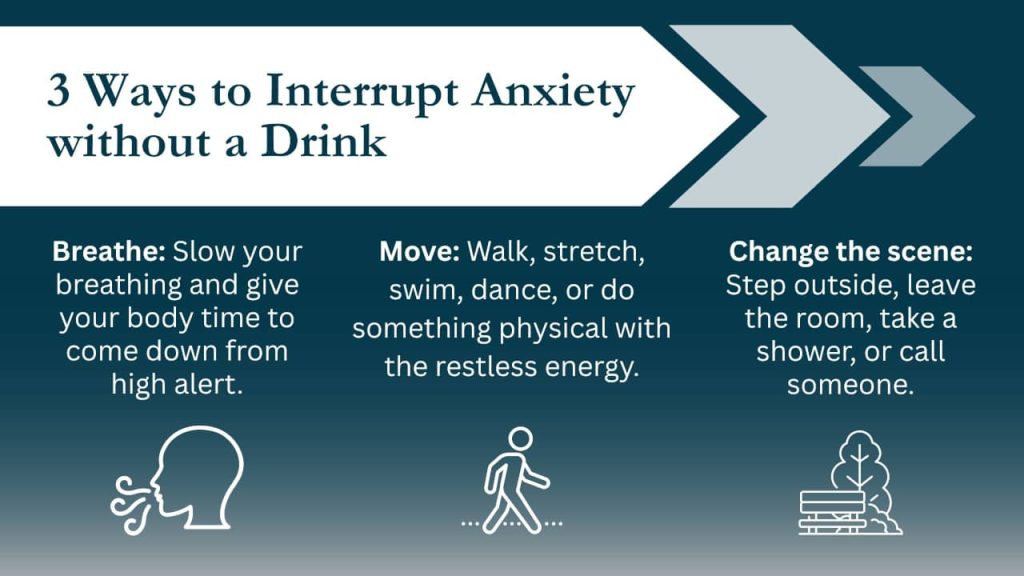
Slowing your breathing can give you a physical point of focus. Try breathing gently through your nose and allowing your exhale to last slightly longer than your inhale. You do not need to force yourself to feel calm. The goal is simply to slow things down.
Research on breathing practices suggests that structured respiratory techniques can reduce anxiety symptoms, especially when practiced consistently rather than used only in moments of crisis.
Grounding can help for the same reason. Notice what you can see, hear, feel, or touch. Pay attention to your feet against the floor or the temperature of the room. The point is not to argue with anxiety. It is to remind your nervous system that you are here, in this moment, rather than inside every future scenario your mind is producing. Regular meditation and mindfulness practice builds this skill over time, so it is easier to reach for when anxiety rises.
Move Your Body
Sometimes anxiety creates more physical energy than your body knows what to do with. In those moments, movement can be more helpful than sitting still and trying harder to relax.
Walking, stretching, swimming, riding a bike, doing yoga, or simply moving around your house can help release some of that restless energy. Research supports physical activity as one useful part of anxiety management, with studies showing reductions in anxiety symptoms among people who participate in regular exercise.
The movement does not need to be intense. Sometimes a 15-minute walk is enough to create a little more space between the feeling and the urge to drink.
Change the Setting
Cravings often become connected to familiar places and routines.
If you usually come home, sit in the same chair, and immediately pour a drink, staying in that exact environment while trying not to drink may make the urge stronger. Changing the sequence can interrupt the habit.
You might walk before going inside, shower as soon as you get home, call someone during your commute, sit outdoors for a while, or stop somewhere that is not associated with drinking. Sometimes how to destress without alcohol is less about resisting a craving and more about changing the conditions that usually trigger it.
How to Relax and Unwind Without Alcohol After Work
For many people, the hardest drink to replace is not the drink at a party. It is the after-work drink that marks the end of the day.
The glass of wine says work is over. The beer says you can stop thinking. The cocktail creates a boundary between responsibility and rest.
If you take away the alcohol but leave an empty space where that ritual used to be, the evening can feel unfinished.
Build a New Wind-Down Ritual
Instead of focusing only on what you are removing, create another signal that the workday has ended.
That might mean changing clothes as soon as you get home, taking a shower, making a favorite nonalcoholic drink, walking outside, stretching, cooking while listening to music, or sitting somewhere quiet for 20 minutes before starting the rest of your evening.
At first, a new routine may not create the same immediate shift that alcohol does. That does not mean it is not working. You are building a new association, and associations get stronger with repetition.
What to Do Instead of Drinking to Relax
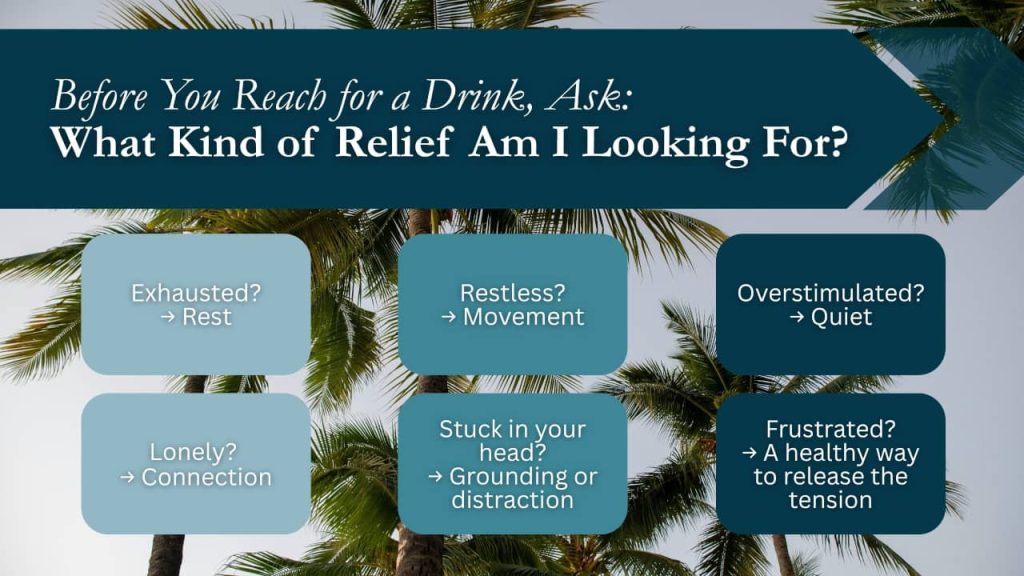
It can also help to ask what you actually need when you say you want to relax.
If you are exhausted, you may need rest. If your mind is racing, you may need grounding or distraction. If you are angry, movement may help. If you feel isolated, the need may be connection rather than sedation.
Alcohol can temporarily blur all of these needs together. Learning how to relax without alcohol often starts with identifying what kind of relief you are actually looking for.
Healthy Alternatives to Alcohol for Anxiety in the Long Run
Getting through one anxious moment matters, but long-term change usually requires more than emergency coping tools.
Sleep, caffeine, food, movement, relationships, and stress all influence how manageable anxiety feels. If you are regularly underslept, skipping meals, relying heavily on caffeine, and moving very little, your body may already be in a state that makes anxiety easier to trigger.
Therapy can also help address the anxiety underneath the drinking. Cognitive Behavioral Therapy, or CBT, is one of the most well-studied treatments for anxiety disorders. It can help people notice anxious thought patterns, reduce avoidance, and gradually approach situations they have learned to fear.
When anxiety and alcohol use have become intertwined, it can be especially helpful to address both at the same time, an approach known as dual diagnosis treatment. Someone with trauma-related anxiety may need a different approach than someone with panic attacks or social anxiety. Treating the underlying emotional patterns can make alcohol feel less necessary as a coping tool.
Handling Social Anxiety Without Drinking
Social anxiety can make alcohol especially tempting because it seems to solve several problems at once. You may talk more easily, think less about how you are coming across, and feel less physically tense.
Research has found that people with social anxiety may be more likely to drink specifically to cope with social discomfort, and drinking for that reason can be linked with greater alcohol-related problems.
Learning to handle social anxiety without drinking may feel awkward at first. It can help to make the situation easier rather than expecting yourself to suddenly feel completely confident.
Arrive before a room becomes crowded. Bring a supportive friend. Give yourself permission to stay for an hour instead of the entire night. Keep a nonalcoholic drink in your hand if that helps you feel less conspicuous. Take a short break outside when you need one.
Most importantly, remember that feeling anxious does not mean the interaction is going badly. Part of working through social anxiety is learning that discomfort can be present without needing to escape it immediately.
Coping With Life Without Alcohol When Cravings and Setbacks Come
Changing your relationship with alcohol does not mean you will stop feeling anxious or never want a drink again.
Cravings may show up after a terrible day, at a wedding, during conflict, or when you suddenly encounter an old routine. That does not mean you have failed.
Sometimes the most useful response is simply to delay. Eat something. Change locations. Call someone. Take a walk. Shower. Remind yourself what usually happens after the first wave of relief wears off.
If you do drink when you had planned not to, try to look at what happened before the setback rather than treating it as proof that change is impossible. Were you exhausted? Lonely? Anxious? Around people or places strongly associated with drinking? A setback like this is often a lapse, not a full relapse, and it can show you where your coping plan needs more support.
One important caution: if you have been drinking heavily or regularly and may be physically dependent on alcohol, suddenly stopping can be dangerous. Alcohol withdrawal can become medically serious and, in some cases, life-threatening. A healthcare professional can help determine whether medical supervision or detox is appropriate.
When Anxiety and Drinking Need Professional Help
You do not need to wait until anxiety or drinking completely disrupts your life before reaching out.
It may be time to consider professional support if alcohol feels necessary for sleep, socializing, relaxing, or managing stress; if you repeatedly drink more than intended; if anxiety is interfering with work or relationships; or if you have tried to cut back but keep returning to the same pattern. For some people, the most helpful next step is residential alcohol treatment, which offers time and space to work on anxiety and drinking together, away from everyday triggers.
At The Ohana Hawaii, treatment can address both substance use and the mental health concerns that may be helping maintain it. Evidence-based approaches such as CBT, DBT, psychodynamic therapy, trauma-focused work, individual therapy, and group therapy can help clients understand what happens before they reach for alcohol and develop other ways of responding. If you are considering alcohol rehab in Hawaii, our admissions team is here to answer your questions and help you decide on a next step.